As an Amazon Associate, Modded gets commissions for purchases made through links in this post.
You’ve mastered digital worlds and conquered online leaderboards. But there’s a parallel universe of tabletop strategy that offers something different — face-to-face competition where clever planning beats brute force. Eurogames are sophisticated board games that feel more like resource management sims than the dice-rolling luck-fests you remember from childhood. Here’s what makes them special, plus seven games that will completely rewire your understanding of what a board game can be.
So What Exactly Is a Eurogame?

Think of Eurogames as the strategy RPG to Ameritrash’s chaotic deathmatch. Classic games like Risk thrive on direct conflict and dice rolls. Eurogames flip that script. They reward efficiency and clever planning over lucky rolls and backstabbing your friends into oblivion.
The mechanics feel familiar if you’ve played city builders or resource management sims. You’re optimizing systems and building engines that generate more actions and points. Combat takes a backseat. Sometimes it disappears entirely.
Modern gamers are catching on. In a recent survey of over 1,600 gamers, mechanics like engine-building and drafting have preference ratings above 70%. Direct player elimination sits at a sad 39%.
Eurogames vs. Ameritrash: A Quick Comparison
Here’s how the two styles stack up.
| Eurogames | Ameritrash | |
| Conflict | Indirect competition for resources and space | Direct combat and player elimination |
| Luck | Minimal luck with strategic dice use or card management | Heavy dice rolling and random events |
| Winning | Victory points from multiple paths | Last player standing or total domination |
| Theme | Theme serves mechanics | Mechanics serve theme |
Those are the philosophical differences. Now here are seven such games that will change how you see board games for good.
1. Catan: It’s A World of Building, Not Burning

This is the OG that brought Eurogames to the mainstream. In Catan, you collect and trade wheat, sheep, bricks, stone and wood to build cities. Trading with other players gets you what you lack.
Picture Age of Empires or Civilization, but the victory condition is economic development through smart deals. The map generates different resources based on dice rolls. The tension comes from a shared economy and racing for limited real estate.
Catan proves you can win by being a better builder instead of a better destroyer. The game sparked a revolution when it launched in 1995, and it still holds up today. Strategy and euro games captured a massive 28.4% slice of the market share in 2024, while war games trailed at 24%. That’s largely thanks to a decade of games following Catan’s pioneering footsteps.
2. Ticket to Ride: Simple Rules Can Still Be Deeply Strategic
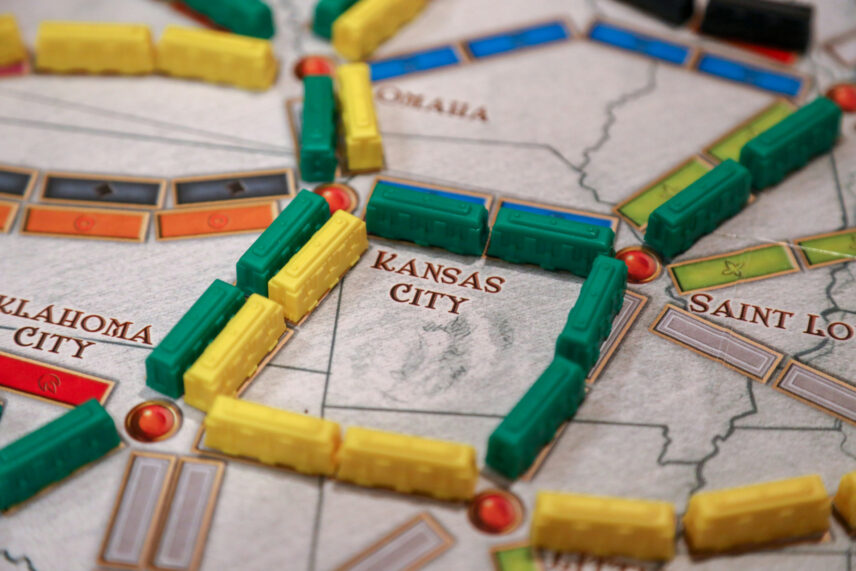
You can teach this game in under five minutes. Players collect colored train car cards to claim railway routes across a map. Longer routes score more points. That’s it.
But the strategy runs deep. Your opponent can block the critical route you need for your cross-country connection. You have to decide when to draw new destination tickets and risk getting stuck with impossible goals. Do you claim that important route now or gamble on one more turn to grab better cards?
It’s the ultimate “easy to learn, hard to master” experience. The kind of elegant design that proves a 50-page rulebook isn’t required for meaningful decisions.
3. Carcassonne: The Board Is What You Make It

This tile-laying game gives you procedural generation at the tabletop. Players build a medieval landscape one square tile at a time. Cities, roads, monasteries and fields emerge from collective choices. After placing a tile, you can claim a feature with one of your meeple followers to score points.
The board is unique every time you play. You might extend your own city while simultaneously cutting off an opponent’s road. The tactical depth comes from reading the remaining tiles and positioning yourself for maximum scoring opportunities.
It has an almost zen-like quality as the map grows. These games boost imagination and cognitive thinking in ways that offer a refreshing break from screen time. Think of it as a competitive, turn-based world-builder where everyone contributes to the terrain but fights to control the most valuable parts.
4. Dominion: The Best Part of the Game Is Building Your Deck

Dominion created the deck-building genre that video games like Slay the Spire and the deck-crafting aspect of Hearthstone borrowed. Everyone starts with an identical weak deck. You use cards to buy better cards from a shared supply and add them to your deck. The goal is building an efficient engine that generates enough purchasing power to grab victory point cards.
The revelation hits fast. The game isn’t about the hand you’re dealt. It’s about designing a lean, powerful machine that dominates in the late game. Every purchase matters. You’re constantly evaluating whether to add more economy, more draw or just start grabbing points.
Deck-builders will feel right at home. Everyone else is about to discover why this mechanic is so addictive.
5. 7 Wonders: You Don’t Always Have to Wait Your Turn

The biggest pain point in board games is downtime. Waiting for three other players to take their turns kills momentum. 7 Wonders solves this brilliantly with simultaneous play.
You’re leading an ancient civilization. Each turn, everyone selects one card from their hand, passes the rest to their neighbor and reveals simultaneously. Cards represent buildings, military strength or scientific advancement that you add to your tableau. The drafting mechanic creates fascinating tension. Do you take the card you need or the one your opponent desperately wants?
Because everyone plays at once, the game moves fast. It feels like the draft phase in League of Legends, but for building an entire civilization. Some modern games are pushing boundaries even further. Alchemist has an app that is integral to the game and adds digital elements to physical play.
6. Wingspan: Games Can Be Beautiful and Meditative

Wingspan shattered the stereotype that hobby games need dragons, zombies or medieval merchants. This engine-builder focuses on attracting birds to your wildlife preserves. You spend food resources to play bird cards. Those birds grant new abilities, generate more food or lay eggs that count as victory points.
The components are gorgeous. Every card includes a fact about the bird species. It feels less like cutthroat competition and more like tending a garden that becomes more powerful each turn. Think Stardew Valley or Flower, but with meaningful strategic choices.
The game includes a birdhouse dice tower for rolling food dice. If you get into the hobby there’s a whole rabbit hole of dice choices to explore, including some made from bones from former medical school skeletons.
The success of Wingspan proved players wanted something different. When one of its hotly anticipated successors, Wyrmspan, launched in 2024, it recorded the largest single-day sales in the publisher’s history.
7. Root: Not Everyone at the Table Plays the Same Game

Root takes asymmetry to the extreme. Four factions battle for control of a woodland kingdom. Each faction has completely different rules, abilities and win conditions. It’s like choosing a hero in Overwatch, where everyone plays by different mechanics.
Check out how wild this gets.
- The Marquise de Cat: Playing a logistics and construction game, trying to build up infrastructure
- The Eyrie Dynasties: Playing a rigid programming game forced to follow a strict set of decrees that build momentum but can collapse into chaos
- The Woodland Alliance: Playing an insurgency game, spreading sympathy and plotting revolts
- The Vagabond: Playing a solo RPG, going on quests and managing inventory while playing the other factions off each other
You have to master your own faction while learning to counter everyone else’s unique mechanics. The replayability is off the charts. Apart from Root, there are other asymmetric Eurogame options for every kind of player, including a popular one based on Disney villains for family play.
In Root, like many strategy games, four players is the sweet spot, though most games include built-in variants for smaller groups.
Your Next Game Night Is Calling
These seven games prove that board games evolved way beyond roll-and-move simplicity. Pick one that appeals and grab some friends. You might be surprised how quickly an hour disappears when you’re optimizing your bird engine or plotting your woodland insurgency. Your next game night is calling.