As an Amazon Associate, Modded gets commissions for purchases made through links in this post.
Picture a typical solo shooting session. You launch a jumper, jog to the baseline, fetch the ball and trudge back while the clock keeps running. Coaches face the same challenge with a full roster and a shrinking practice window.
No wonder players and programs are watching how automated rebounding machines are changing basketball practice.
Why Spend Practice Chasing Rebounds?
Great shooters come from volume, and volume takes time. Reggie Miller made 2,560 career three-pointers before he retired, an NBA record at the time, and a stroke like that starts with thousands of practice reps. The catch is that every rep also costs you a jog to retrieve the ball, and your sneakers end up getting more cardio than your jumper.
Automated rebounding cuts out the jogging. The Gun says its 10K shot trainer “delivers up to 1,800 shots per hour, letting players and teams accomplish more in 30 minutes than traditional practice methods achieve in two hours.” That kind of volume is changing basketball practice at every level.
A machine handling the rebounds changes how a session plays out:
- Traditional practice: You chase every miss, depend on a partner to rebound and get inconsistent passes.
- Automated rebounding: The machine collects every make and miss and fires the ball right back to your spot, so you stay in rhythm.
What Can Real-Time Shot Data Tell You?
Volume only helps if you know which reps are working. Wearables in pro sports can capture thousands of biometric data points per second, and shooting practice is starting to use the same kind of data. If you know you fade on the left wing, you can start working on it right away instead of guessing for a season.
Coaches can get the same edge, since the numbers may show which players struggle from the corners and where the next workout should focus. Some machines put that thinking to work in a few ways:
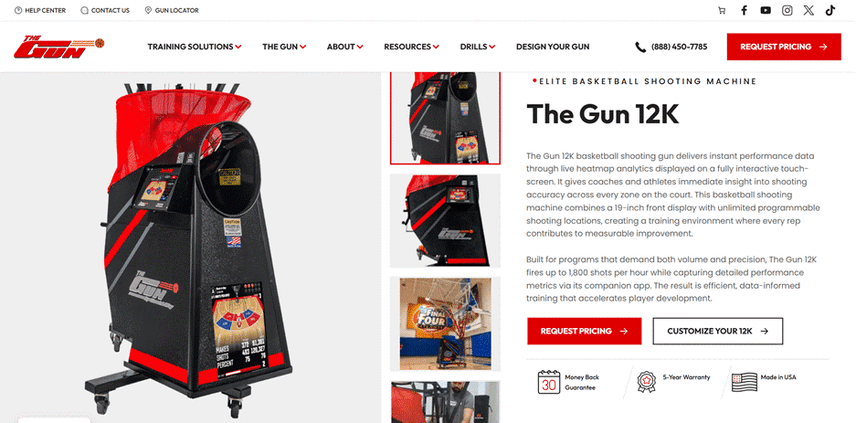
- Live heatmaps: Heatmap analytics show your accuracy zone by zone, so you can see which spots deserve more reps. They appear on the 12K and the 14X Smart Pass.
- Free companion app: It tracks individual and team stats over time, making progress easy to measure.
- Multiplayer tracking: The 14X Smart Pass can log up to eight players in the same workout, so an entire group can share one machine.
How Do You Get More Reps Without Burning Out?
More reps only help if your form holds up. In one 2024 study, high-level players’ three-point accuracy fell from 47.4% to 39.3% after a game-simulation workout. Tired reps may train the wrong habits, which makes quality just as important as quantity.
Recovery matters too. Pushing reps without rest can lead to overuse injuries like tendonitis and stress fractures over time, so even a high-volume plan should build in rest days.
A rebounding machine can help on both fronts. You save your energy for shooting instead of chasing balls, and you can work in short, focused blocks rather than long, exhausting sessions. Coaches running a full roster may see the same benefit, since players spend less time idle and more time working at a pace they can sustain.
Can One Machine Train Every Position on the Court?
The game has changed, and many power forwards now shoot threes as part of the job, so shooting work belongs in every position’s routine. Big men who once stayed near the rim increasingly need a reliable jumper too, and a machine supplies the reps to build one.
Each position can put a machine to work in its own way:
- Guards: Catch-and-shoot threes off chest or bounce passes keep your footwork honest.
- Wings: Spot-ups from both corners and the wings build a quick, repeatable release.
- Bigs: Midrange and pick-and-pop jumpers help forwards and centers stretch the floor.
The 14X Smart Pass adjusts to each player’s height and shooting location, so a 6-foot guard and a 6-foot-10 forward can rotate through the same workout. It also includes more than 250 built-in drills with video instruction, and Decision Mode adds reaction-based training for reading the floor.
What Is the Difference Between The Gun and Dr. Dish?
Dr. Dish also makes basketball shooting machines, so it’s a fair name to set beside The Gun. Subscription costs make a natural starting point.
On that front, The Gun says on its 12K product page, “Full functionality comes standard with no subscription fees. Unlike competitors that charge recurring fees, you get complete access to all features from day one.” That’s the maker’s claim about its own machine, so check each brand’s current terms before you buy.
The Gun brings these strengths to the comparison:
- Free app: The companion app costs nothing to use.
- Made in the United States: The Gun’s maker builds it in the United States, with commercial-grade construction that stands up to heavy use.
- Built to last: Machines commonly run for more than 20 years and come with up to a five-year warranty.
- Industry pioneer: The Gun’s maker originated the basketball shooting machine and has built them for decades.
- 14X Smart Pass: The passing system automatically adjusts to each shooter.
Weighing the difference between The Gun and Dr. Dish comes down to long-term cost, build quality and how much technology you want from day one.
Which Machine Fits Home or Team Training?
Competition starts early, with more than 540,000 high school boys playing basketball in 2024-25 and only 3.6% of them going on to play in the National Collegiate Athletic Association. That squeeze makes every practice minute count, whether you train in a driveway or run a roster.
The right model depends on who is using it:
- Home: The Home Edition suits driveways and garages, though many home buyers choose higher-end models.
- Schools and teams: Pro and School models bring quality construction for programs that put equipment through seasons of daily use.
- Facilities: Gyms and training centers run machines constantly, so U.S.-made durability matters.
What Else Should You Know About Shooting Machines?
Buyers tend to ask the same practical questions before they commit to The Gun. Height, training range and model differences come up most often.
Q: Does The Gun work for younger or shorter players?
A: Yes. The 14X Smart Pass automatically adjusts to each player’s height and shooting location, so a younger player and a varsity starter can share the same workout. The X-Frame is also lighter and easier for players of all ages to position.
Q: Can The Gun train anything besides shooting?
A: The machine centers on shooting, and the 14X Smart Pass adds more. It delivers chest and bounce passes for game-like catches, and Decision Mode adds reaction-based work. It’s also used in volleyball, where it trains passing, setting and decision-making. Coaches can run one as a station in a practice rotation while other groups focus on different skills.
Q: What’s the difference between the home edition and the school models?
A: The Home Edition serves residential use in driveways, garages and home courts. School models such as the 10K and 12K add commercial-grade construction and touch-screen programming. Warranty terms vary by model, with up to five years of commercial-grade coverage on new school models.
Is the Rebound Still Holding Your Game Back?
Practice used to mean chasing balls between shots. Now every minute can go into shooting, with the machine handling rebounds, passes and stats. Whether you train alone in a driveway or run a full roster, modern basketball practice rewards the player who gets more quality reps per minute.