
As an Amazon Associate, Modded gets commissions for purchases made through links in this post.
So you want to become a bartender. It’s no easy task, or at least, not as easy as it may initially seem. In addition to your passion for all things liquor, you’ll also need a strong work ethic, people skills and time to learn the ins and outs of this exciting (but challenging) career.
Is your heart still set on mixology? Then there are a few things you’ll need to know as you begin your journey. Check out this guide to learn more about bartending for beginners.
The Pros and Cons of Becoming a Bartender
People don’t usually decide to become bartenders overnight — regardless of how much they despise their current job. Rather, most take some time to read up on what this career is like, including the advantages and disadvantages that come along with it.
One of the biggest benefits of becoming a bartender is the flexible compensation. According to the Bureau of Labor Statistics, the average wage is about $12.67 an hour for most bartenders in the United States. However, there is room for much more. Some bartenders make as much as a living salary if they work at a high-end establishment and take full advantage of tips.
Depending on where you work, how busy it is and who sits at the bar, you can make $100 or more in tips alone in just a few hours. On the best nights, you’ll make more money through tips than through your hourly rate. Plus, you won’t have to run all over the restaurant like a server.
Of course, every job has its downsides. Bartending is often demanding. Most shifts last eight hours or longer and require high levels of concentration throughout.
Remembering drink orders, chatting with guests and ringing in food can be quite stressful at times, so prepare yourself for some mild anxiety as you begin bartending.

What Qualities Make for a Good Bartender?
As you continue on your path of bartending for beginners, you have to give thought to your personality and general skillset. Bartending isn’t for everyone.
Even if you want to spend every minute of the day mixing cocktails, you may not be cut out for it. At the very least, it might be a very tough uphill climb if you’re not equipped.
Here are a few bartending tips and essential bartending skills you need to be successful behind the bar:
- Good eye contact: Catching and holding someone’s gaze isn’t always easy, especially when you’re speaking to a stranger. That said, eye contact is an essential part of good customer service when behind the bar. You won’t last long if you’re not the sociable type.
- Friendliness: If you don’t have the humility and strength it takes to be overly friendly 100% of the time, becoming a bartender will be a painful transition. You’ll serve rude customers and those who don’t care about how busy you are. Still, you’ll have to assist them with a smile. After all, you want good tips, right?
- Wit: Be prepared to joke around with guests while you’re working. Customers enjoy having a witty bartender because it adds to the laid-back atmosphere they’ve come to enjoy. If you make them laugh, odds are they’ll return, ask for you again and likely tip you well.
- Level-headed demeanor: On busy nights, it’s easy to become overwhelmed by drink orders, incoming guests and everything else going on behind the scenes. However, if you can remain level-headed amid the chaos, you’ll make it through the night — and earn yourself a reputation as someone who can handle the stress that comes with the job.
- Responsibility: Claiming responsibility for your actions will also earn you respect behind the bar. Additionally, you’ll have to take responsibility for guests, especially those who tend to drink one too many. While cutting people off can be uncomfortable, taking responsibility is essential.
- Loyalty: The more time you spend behind the bar, the more you’ll realize that everyone knows each other. If you leave within a year of bartending, the word will get out and you’ll be known as flighty. Good luck getting another bartending job after that!
Bartending Tips for Beginners
Bartending has a significant learning curve for beginners, just like most other jobs in the food service industry. The work is fast-paced and you won’t have time to think, so you must prepare yourself as much as possible before your first day on the job.
These beginner’s tips will ease the transition into your new work environment.
1. Be Adaptable
Before accepting a job at your local restaurant or pub, you should know what to expect going in. Regardless of how much you study or research before applying somewhere, you’ll likely need to adapt to your employer’s rules and list of responsibilities.
Every place is different and will require varying skills, knowledge and capabilities. For instance, one pub may not need you to wash used glasses or deliver food to tables in the bar area while another might.
Thus, you may have more responsibilities at one location than another. If you aren’t ready to embrace your roles and complete your duties, be prepared to suffer the consequences — or get the boot.
2. Be a Team Player
It can be easy to get tunnel vision during a busy bartending shift, but remember — you’re part of a team. You can’t just hang out in one section of the bar and do your own thing. If another bartender is falling behind or a busboy is struggling with a large order of food, give them a helping hand.
An unselfish attitude will boost workplace morale and give you a strong reputation among your co-workers, potentially setting you up for a leadership position in the future. Plus, helping with other miscellaneous tasks keeps the whole restaurant in tip-top shape, making your job behind the bar much easier.
3. Don’t Serve Customers One at a Time
Serving customers one at a time is a bad beginner’s habit you need to avoid. This serving strategy quickly creates a backlog of people waiting around at the bar. It’s better to take orders in multiple batches — three orders at a time is a good starting point — so you can prepare drinks in bulk and deal with multiple payments in one trip to the credit card machine.
Experienced bartenders know how to keep the lines moving no matter how busy the place gets. Once the backlog starts, it quickly snowballs into a crowd of half-drunk and impatient customers. Taking multiple orders at a time establishes a necessary sense of urgency.
4. Remember Your Regulars
Every bar has a handful of regulars that usually show up during the slowest hours of the week. These people are your most important customers. If you get along well with them, they’ll give you the biggest tips and make your job less stressful. They can even indirectly help with your career progression through word of mouth by telling other patrons about your excellent service.
5. Expand Your Palette
If you want to make it far in the bartending business, you need to expand your palette. Trying different drinks is vital for understanding how they’re supposed to taste and making accurate measurements. It will also help you “sell” the drinks to customers because you can describe the flavor in greater detail.
6. Use Your Downtime Wisely
Bartenders don’t have much downtime during their shifts, so you need to use it wisely. You can always do something productive, whether it’s cleaning glasses, wiping down the counter or restocking ingredients. If there’s nothing to do behind the bar, then do whatever you can to help the kitchen or waiting staff.
7. Take Care of Your Feet
Any experienced bartender will tell you to invest in a quality pair of shoes before your first shift. You need to take good care of your feet if you want to work a full shift without discomfort. Bartending with foot pain is a recipe for disaster because you’ll be in a bad mood and make more mistakes.
8. Stay in Good Shape
You also need to stay in good physical shape overall. Bartending will be much easier if you have the stamina to keep moving for an entire shift without getting exhausted. Raw strength is also a positive trait because you might need to help the bouncers escort unruly customers out of the building at some point.
9. Smile More
Smiling is the best thing you can do in any customer service setting. It makes a good impression on the customers, creates a positive atmosphere around the bar and often leads to bigger tips. Plus, smiling more often can significantly lower your stress levels by triggering the release of endorphins such as dopamine and serotonin.
10. Never Over-Serve
Lastly, you should never over-serve customers if they’re visibly intoxicated. Being drunk is one thing, but once they stumble around and slur their words, it’s time to cut them off. Over-serving customers can lead to a world of legal troubles.
Overview of Different Bar Tools
Once you’re hired, learn how to use the tools of the trade and gather any essentials your employer requires you to have on hand, such as a bottle opener and grater.
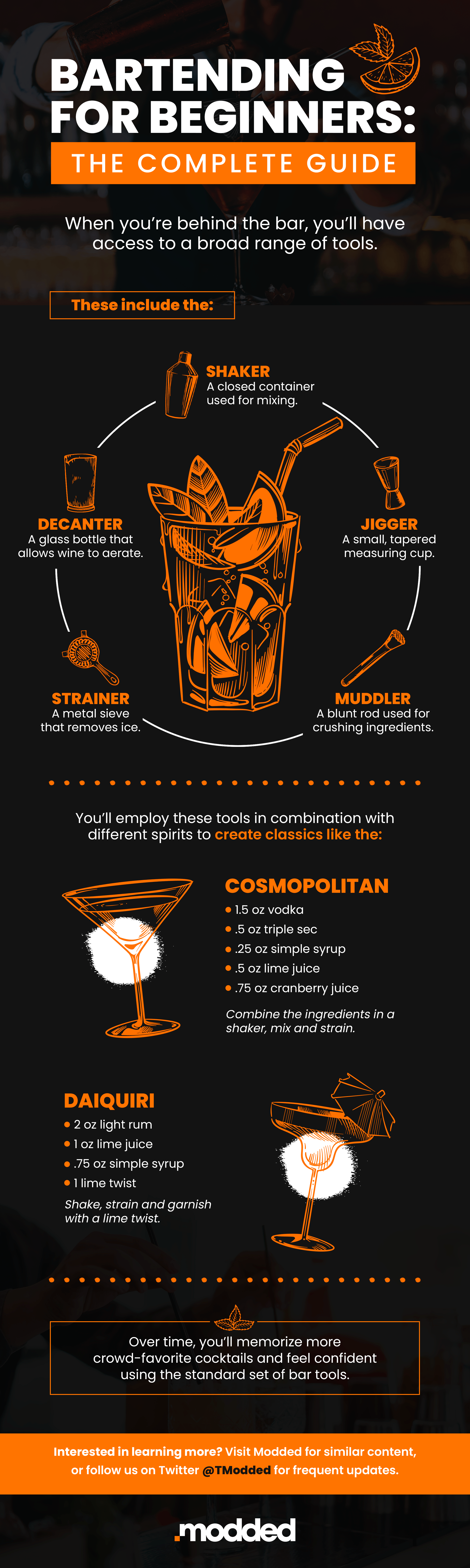
Here are a few basic bartending tools you’ll need as you study up on before you begin bartending:
- Shaker: Whether you’re making a cosmo or a gin martini, you’re going to need a shaker. Understanding how to keep the lid and body in place while you shake will reduce leaks and spills and prevent you from making a mess.
- Jigger: Jiggers are small tapered measuring cups that you use to measure out one- and two-ounce shots of liquor. Learning how to use one is relatively straightforward.
- Muddler: Some cocktails require you muddle mint leaves, lime slices and other ingredients. Rather than use a fork or — God forbid — the butt end of a spoon, get yourself a muddler. It’s the best tool for the job.
- Strainer: Strain cocktails with large ingredients and pulp using a Julep, Hawthorne or fine strainer. These tools make for a smoother drinking experience.
- Decanter: Allow fine wines time to aerate by pouring them into a decanter. Let the wine sit for a few minutes, then pour a few glasses for your guests to enjoy.
- Wine preservation system: If you work at a fancier bar, you may have to use a wine preservation system. This device opens and closes bottles while maintaining pressure inside the container.
- Citrus Press: Cocktails are best served with real juice straight from the fruit. A citrus press will help you extract all of the juice and create more flavorful drinks.
- Bar Spoon: A long bar spoon is great for stirring tall drinks and evenly distributing the ingredients.
- Bottle Openers: You always need different bottle openers for beer, wine and champagne bottles.
- Knife: A small reliable knife is essential for cutting cocktail ingredients and garnishes neatly.
- Pen and Paper: A pen and paper should always be within arm’s reach so you can quickly take orders and open up new tabs.
- Lots of Towels: You’ll need lots and lots of towels to keep your hands clean, dry off glasses and wipe down the bar.
Begin practicing the tricks of the trade at home with your own bartending starter kit. Doing so will give you a head start when you do begin training in a pub or restaurant.
Creating the Classics
Instead of trying to learn all the complicated drink variations at once, begin by making and mastering the classics. Every guide that goes over bartending for beginners will have these staples.
1. Cosmopolitan
Make a cosmopolitan by throwing the following ingredients together:
- 1.5 oz of vodka
- .5 oz triple sec
- .25 oz simple syrup
- .5 oz lime juice
- .75 oz cranberry juice
Shake the ingredients together and serve.
2. Beer Margarita
Whip up a beer margarita with these ingredients:
- 1 can limeade concentrate
- 12 oz tequila
- 6 oz of Sprite
- 6 oz of water
- 12 oz of your beer of choice
- Ice
Mix and serve frozen or chilled. This recipe makes eight 6-ounce servings.
3. Daiquiri
The classic daiquiri is easy to make if you have these things on hand:
- 2 oz light rum
- 1 oz lime juice
- .75 oz simple syrup
- 1 lime twist
Shake, strain and serve.
4. Old Fashioned
The first official version of this cocktail was coined back in 1806, and this drink has a timeless recipe:
- .5 teaspoons of sugar
- 3 dashes Angostura bitters
- 1 teaspoon water
- 2 oz bourbon
- Orange peel garnish
Fill the glass with large ice cubes, gently stir and serve.
5. Mojito
This Cuban classic is a pool party staple, but this recipe is fit for any occasion:
- 3 mint leaves
- .5 oz simple syrup
- 2 oz white rum
- .75 oz lime juice, freshly squeezed
- Club soda, to top
- Mint sprig and lime wheel garnish
Either shake and strain the ingredients into a highball glass or mix them with pebble ice.
6. Martini
Martinis have several variations, but nothing beats the classic dry martini:
- 2.5 oz gin
- .5 oz dry vermouth
- 1 dash orange bitters
- Lemon twist garnish
Stir the ingredients with ice until the concoction is freezing cold, then strain the drink into a chilled cocktail glass.
7. Manhattan
Many bartenders have made tweaks over the years since its origins in the 1880s, but the first recipe still stands out:
- 2 oz rye whiskey
- 1 oz sweet vermouth
- 2 dashes Angostura bitters
- 1 dash orange bitters
- Brandied cherry or lemon twist garnish
Stir until chilled, strain into a chilled coupe and serve.
Familiarize yourself with these cocktails — and the other classics — before taking more complicated drink orders. A standard bartending starter kit should have enough for the aforementioned recipes and more.
Studying the Liquors
Study and know the different types of liquors like the back of your hand. Doing so before you begin taking and making orders will make your life a million times easier.
Begin by reading up on the six base liquors — brandy, rum, tequila, gin, whiskey and vodka. Research the history behind each alcohol and try to have a basic understanding of which drinks require each one. Here’s a quick overview of each type.
1. Brandy
Brandy is a liquor often served on its own. It’s distilled with wine and fruits such as grapes and apples, then aged in oak barrels to give it that caramel coloring. You might hear people call it “fruit brandy” and other unique names based on the region’s distillation ingredients and fermentation process.
The most popular brandy styles – cognac, Armagnac and grappa, to name a few – come from Europe, where people have been distilling the drink since the 15th century in several countries. In fact, the name “brandy” originates from the Dutch word brandewijn, which means “burned wine.” This name accurately describes the drink’s sweet yet firm taste.
2. Rum
Rum is another sweet liquor that sometimes resembles brandy, but the production process is quite different. It comes from fermented sugarcane juice or molasses, then aged in oak barrels until it gets the distillery’s desired coloring. The loose restrictions around rum production make it a highly versatile drink and a popular base for creative cocktails.
There are many types of rum, but beginners should know the three basic categories: white, spiced and dark. All three have origins in the American colonies, where settlers used the region’s abundance of sugarcane to create many varieties with experimental distilling methods. It was especially popular among sailors as it was available in every port and made their jobs more tolerable – hence the pop culture connection between rum and pirates.
3. Tequila
Tequila arguably packs the strongest punch, hence its popularity as a spicy cocktail base and a party shot. It’s distilled from the blue agave plant’s fermented juices, giving it a green, earthy flavor profile. It’s also the most tightly regulated liquor, as it can only be produced in Mexico and has strict distillation requirements.
The drink’s namesake is the city of Tequila in central Mexico, where the volcanic soil makes a perfect home for the blue agave plant. Locals have been making the drink since the 1500s, and it became so synonymous with the area that Mexico declared the term “tequila” intellectual property in 1974.
4. Gin
Gin is a dry liquor distilled from neutral grains like barley, wheat and corn. It gets its flavor from juniper berries and other botanicals added afterward, depending on the brand. Although not an exciting liquor, it pairs well with simple cocktails like martinis.
Gin is most popular in Europe, where it first appeared as a medicinal drink as early as the 11th century. It surged in popularity in the 1600s as an alternative to brandy. It became the official drink of England and is also the go-to liquor in Belgium and the Netherlands.
5. Whiskey
Whiskey is another versatile liquor, distilled from one or several malted grains and aged in charred oak barrels. Because of the distillation options, there are different types of whiskey: bourbon, rye, scotch and many others. The only unifying trait is that the drink ages for at least two years in a wooden barrel. The grain mash and type of wood are up to the producer.
Whiskey’s name comes from the Gaelic word uisge, which means “water,” but there’s an ongoing debate about the modern spelling. In Ireland and the United States it’s spelled “whiskey,” but other countries use the more traditional “whisky.”
6. Vodka
Vodka has a neutral taste on its own, but it mixes with just about anything. It can also be distilled from most fermented foods, including grains, potatoes, beets and grapes. The flavor doesn’t change much between these distillation methods, but the texture can vary from oily to downright rough.
Unlike the other liquors that got their starts in Western Europe, vodka originates from Eastern Europe and the Slavic word voda, which means “little water.” Its first confirmed appearance in early-1500s Poland and Russia was for medicinal purposes, but soon it became a mass product. New distillation methods gave way to the stronger drink we know today.
Understanding the Lingo
If you’ve ever heard bartenders call to one another behind the bar, you may have noticed they have their own language.
Whether they’re asking for a “bev nap” or want you to make a drink dirty, you have to understand the lingo to be a successful bartender and effectively help out your fellow mixologists.
Read up on common terminology to better prepare yourself for your new career. Then, continue to add new terms to your arsenal as you work. Here are a few basic terms to know:
- Straight up: Nothing but alcohol. No ice.
- Neat: Nothing but alcohol — but just one type of alcohol.
- Up: A drink that’s chilled, but without ice in the glass.
- On the rocks: The drink served over ice.
- Shaken: Aerating a drink by shaking for about 15 seconds.
- Stirred: Cooling a drink slower, with less dilution.
- Back: Non-alcoholic drink alongside the drink itself.
- Chaser: Something to drink immediately after a shot.
- With a twist: A piece of lemon peel as a garnish.
- Bev nap: A small napkin for beverages.
- Dirty: A drink mixed with the juice of bar olives.
- Mixer: Any non-alcoholic liquid used in a cocktail, such as soda or lime juice.
- T