As an Amazon Associate, Modded gets commissions for purchases made through links in this post.
Automakers are focusing on extended-range electric vehicles (EREVs) to meet consumers’ demand for greater driving range. The first series hybrid vehicles hit the market in the early ‘10s, a period when the EV market was nascent. Back then, carmakers understood that sustainability was the future, but expensive zero-emission automobiles unsuitable for long-distance road trips were a hard sell. Auto brands discontinued their range-extended models to allocate resources to more promising products, such as plug-in hybrid vehicles.
Fast-forward to the mid-2020s, plug-in hybrids have failed to gain traction. Their selling points have been underwhelming at best and confusing at worst. After spinning their wheels for so long, car companies have acknowledged that EREVs make more cost-effective transitional vehicles for motorists who aren’t ready to drive full electric.
By January 2026, only a handful of extended-range EVs had been available for sale. Model availability should expand soon, as the auto industry goes full throttle on launching these EREVs over the next three years.
Ram 1500 REV
Formerly Ramcharger, the 1500 REV graced the 2026 Detroit Auto Show. This electric truck with an onboard gas generator has a total range of 690 miles on a full tank, 145 of which are on pure electricity. It can tow 14,000 pounds and haul 2,625.
Stellantis, Ram’s parent company, has scheduled production for the 1500 REV in the second half of 2026. Both the 2026 and 2027 models have made headlines, so expect sales to begin before the year ends.
Jeep Grand Wagoneer REEV
The Grand Wagoneer REEV uses the same hybrid powertrain as the 1500 REV. Its battery pack can last 240 kilometers, or about 150 miles, on a single charge and a total of 800 kilometers to the last drop of gas in its onboard generator.
Jeep’s manufacturing plant should start churning out Grand Wagoneer REEVs in 2026, hoping to earn the distinction for being the first extended-range EV SUV in the United States.
Nissan Rogue e-POWER
Nissan has repeatedly hinted that the next-gen Rogue will arrive in the U.S. in late 2026, marking the debut of its e-Power technology there. This compact SUV isn’t externally rechargeable. This Rogue’s 1.5L engine only serves as a generator to power its small battery once it runs out of juice.
BMW X5 REx
BMW’s gas-electric range-extender drivetrain may make a comeback sooner rather than later, with the launch of the sixth-generation X5. The luxury brand plans to integrate the range extender tech it shelved years ago into its electric SUVs to boost sales, inspired by the success of EREVs in China and hampered by infrastructure constraints in the U.S.
Ford F-150 Lightning EREV

The next generation of the F-150 Lightning, which may be available for sale in late 2026 or early 2027, combines electric motors and a gas generator, underscoring the Blue Oval’s strategic shift from battery-only EVs to more profitable extended-range units.
Ford estimates the 2027 model can run over 700 miles, a far cry from the F-150 Lightning XLT’s 240-mile range and more than twice the ground the Platinum can cover on a full charge. You shouldn’t expect unpleasant surprises with this EREV, as it retains Pro Power Onboard and can export electricity to external devices.
Scout Traveler
The Traveler is an off-road SUV with an electric drivetrain with all-wheel drive, blending ruggedness, luxury and sustainability. Scout Motors, a marque acquired by the Volkswagen Group in 2021, pays homage to its International Harvester pedigree. Expect the Traveler to marry 21st-century in-car amenities with ‘70s and ‘80s aesthetics.
Scout envisions this EV to run a total of 350 miles per charge and offers a variant with a four-cylinder gas engine as an extender, causing the range to exceed 500 miles. The automaker plans to start production and sales for the 2028 model in 2027.
Hyundai Santa Fe EREV
Hyundai is rolling out range-extender versions of the Santa Fe in the U.S. and China. The Korean automaker is developing a two-motor system, with the gas engine designed solely for charging to ensure electric-only motoring.
Local regulations dictate mandatory vehicle features, and rarely do automakers redesign their cars for specific countries — not even the U.S. Santa Fe EREVs in the States may have nonfunctioning buttons meant for controls required in China, and vice versa. More information about the EV’s features should make headlines, as Hyundai’s target mass-production date in 2027 nears.
Genesis GV80 EREV
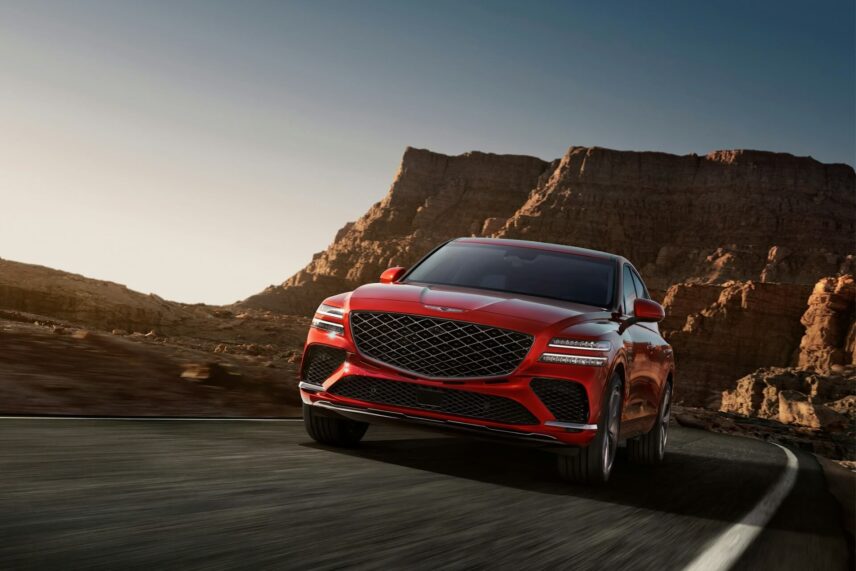
Codenamed JX2, the second-generation GV80 may come with a range extender for regions with lackluster EV demand. Many consider its gas-powered incarnation as the leading luxury SUV, so capitalizing on its appeal to entice status-conscious motorists to go electric is a wise decision.
Genesis plans to build it on a new dedicated platform called Trinity and achieve a combined range of about 560 miles. The company’s Magma division is responsible for developing the GV80 EREV, promising high-performance, luxurious daily driving. The Korean brand has scheduled the unveiling of the entire Magma lineup in 2027.
Scout Terra
The Terra has a towing capacity of over 10,000 pounds, but it shares much of the same tech as its EREV sibling, the Traveler. This off-road beast features software built on modern zonal architecture capable of remote diagnostics and over-the-air updates.
Same as Scout’s extended-range SUV, this truck also features the proprietary Harvester™ energy system to recharge its high-voltage battery and expand its total range to over 500 miles. The brand has accepted reservations for the Terra since October 2024 and has scheduled initial production to begin at its South Carolina facility in 2027.
Volvo XC90 EREV

Volvo has announced production of the XC90 EREV at its South Carolina plant in late 2028, following the rollout of its so-called second-generation plug-in hybrid, the XC70 EREV, in China in 2026. It’s an opportunity for American consumers who love the all-wheel drive SUV’s advanced driver-assist tech and excellent safety features but are on the fence about driving all-electric to experience the automaker’s reimagined hybrids soon.
The Swedish manufacturer believes that the gas engine should still be able to directly power the wheels for freeway driving. This philosophy contradicts the mechanisms of many currently available and upcoming extended-range EVs.
EREVs Ease the Transition to Electric Mobility
The pivot to electric vehicles is a significant but worthwhile gamble, but underwhelming sales prove that traditional plug-in hybrid vehicles are an unsafe bet. EREVs embody what most motorists want but couldn’t see in plug-in hybrids, so the above extended-range models should yield better returns for automakers.