As an Amazon Associate, Modded gets commissions for purchases made through links in this post.
Rivian has never been short on ambition, but at its recent Autonomy & AI Day in Silicon Valley, the American EV manufacturer has made it clear that it’s no longer content to watch the self-driving race from the sidelines. It shared tons of exciting announcements, including its own AI chips and plans to achieve Level 4 autonomous driving in the future. Here are the top four things you need to know about the future of Rivian’s autonomous driving.
1. Rivian Is Building Its Own AI Chip
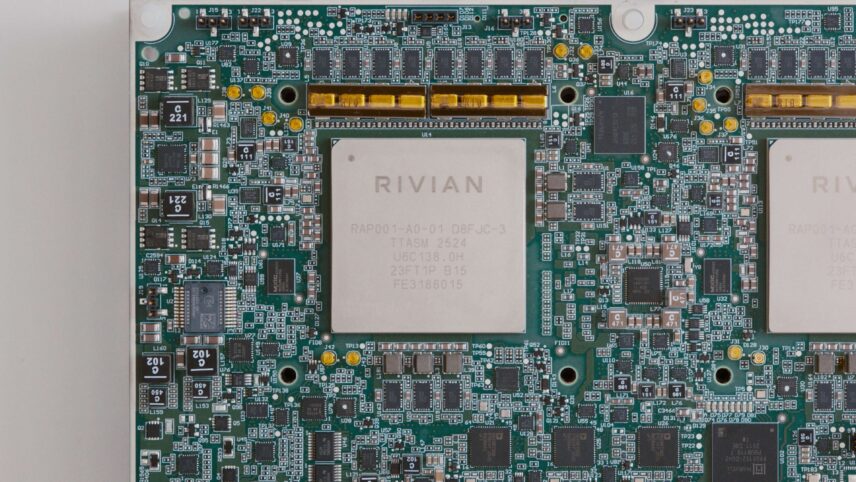
One of the headline announcements from Rivian Autonomy & AI Day is the brand’s decision to design its own in-house custom silicon chip called the first-generation Rivian Autonomy Processor (RAP1), which is specifically designed for vision-centric physical AI. This is the brain that powers its new third-generation computer architecture — the Autonomy Compute Module 3 (ACM3). With this move, Rivian joins a small group of automakers developing proprietary chips. Several manufacturers rely on Nvidia Chips, such as GM, Hyundai and Toyota.
RAP1 combines processing and memory into a single multi-chip module and is built to meet strict automotive safety standards. Rivian says it can handle up to 1,600 sparse INT8 trillion operations per second and process five billion pixels per second.
By comparison, Nvidia’s H100-class GPUs are typically quoted at 3,000-3,900 INT8 TOPS with sparsity on datasheets. The GPUs are widely used for next-generation AI by entities like Meta, Tesla and XAI/X. Additionally, RAP1 features RivLink — a low-latency system that lets multiple chips work together and runs on Rivian’s own AI compiler and platform software.
2. Lidar for the Upcoming R2 Vehicles
Rivian is pairing the ACM3 with a lidar sensor, which will be introduced in later versions of the upcoming R2 starting in late 2026. Designers mounted the sensor near the windshield and paired it with cameras and other sensors to deliver 3D spatial data and added redundancy. This combination can facilitate real-time detection, particularly in complex or unexpected driving scenarios.
Lidar is already a core component of autonomous driving due to its high detection accuracy. It’s widely used in robotaxi systems. Businesses like Waymo use it to generate highly detailed 3D maps of their surroundings.
Interestingly, Rivian also hinted at plans to pursue robotaxis during its Autonomy & AI Day. The robotaxi space has been steadily expanding in recent years, and companies such as Tesla have also spoken about focusing on it, though the launch has yet to materialize.

3. Hands-Free Now, Eyes-Off Next
During the Autonomy & AI Day, Rivian also announced that it has been building a large driving model (LDM), which is trained similarly to large language models like OpenAI’s ChatGPT. Instead of text, it learns from vast amounts of real-world driving data to determine better driving strategies and feed them back into the vehicle through continuous software updates.
The company’s goal with this is ultimately to achieve Level 4 self-driving capabilities — a level defined by the Society of Automotive Engineers (SAE). At this level, cars can operate entirely by themselves without human supervision.
Building on its LDM, Rivian plans to roll out a software update that includes “Universal Hands-Free” in early 2026, also known as Level 2 Plus. It’s a significant expansion from earlier coverage and will extend beyond highways. If you have a second-generation R1 truck or SUV, you’ll be able to access the expanded capabilities through Rivian Autonomy+ subscription, which is available with a one-time fee of $2,500 or a monthly cost of $49.99.
Eyes-off driving comes next. Rivian’s self-driving vehicle plans include Level 3 autonomy that will allow drivers to take their hands and eyes off the wheel. This would place it closer to makers like Mercedes-Benz, which achieved Level 3 autonomy with the SAE in 2023.

4. AI-Powered Voice Assistant
Rivian’s AI-powered voice assistant is on the way, scheduled to launch in early 2026 for both first- and second-generation R1 vehicles. The Rivian Assistant will be built directly into the vehicle’s systems and will handle tasks through natural voice interactions, plus work with third-party apps like Google Calendar.
An AI voice assistant in cars is becoming increasingly common. Tesla, for instance, has added the infamous Grok to vehicles running AMD processors. Drivers can speak to Grok in real time, asking practical questions like where to eat, when a restaurant closes, or what the weather and traffic look like ahead. Similarly, Rivian’s AI voice assistant can perform practical tasks, allowing you to ask it to warm up the seats or reschedule an upcoming meeting.
Rivian Is Late but No Longer Behind
Rivian’s autonomous driving is not leading the pack yet. However, the Autonomy & AI Day shows that the enterprise now has a coherent, end-to-end plan for self-driving vehicles. Who knows — maybe it will soon catch up with the big players.