
As an Amazon Associate, Modded gets commissions for purchases made through links in this post.
Despite being one of the most documented events in history, many facets of World War II still hold some deeply intriguing secrets. From ghost planes to missing treasures and elusive leaders, nobody is likely to solve every mystery from the period. These real-life enigmas have inspired umpteen captivating stories in modern media, inviting audiences to explore the unknown and keeping the mysteries as relevant as if they’d only happened yesterday.
This article will examine a selection of WWII’s most puzzling mysteries, highlighting why they still fascinate many of the era’s followers.
1. The Vanishing of the Amber Room
The Amber Room, located initially at Tsarskoye Selo, near Leningrad, Russia, was adorned with intricate amber panels and gold leaf, earning it the nickname of the “Eighth Wonder of the World.” Its breathtaking beauty captivated many until German soldiers looted it from its Catherine Palace home in 1941, taking its contents to Königsberg Castle, Germany. Three years later, the lavish collection of riches vanished, never to be seen again. Theories abound regarding its fate.
Speculation is that the chaos of Allied bombings at the time destroyed the Amber Room or that the Nazis hid it away in a secret bunker or lost it at sea after loading its contents onto a ship that subsequently sank. Nobody knows, and the closest anyone has come to viewing its splendor is through modern-day replicas at Russia’s Tsarskoye Selo State Museum and, more recently, in Mamerki, Poland, just outside Königsberg. The hunt for the original remains a multi-million-dollar endeavor, captivating many treasure hunters and historians alike.
2. The Solo Flight of Rudolf Hess
In May 1941, Rudolf Hess, Hitler’s Deputy, made an astonishing 1,000-mile solo flight to Scotland in a Messerschmitt Bf 110 twin-engine fighter — a move that shocked both Allied and Axis leaders alike. His reported intention was to broker a peace treaty with the Duke of Hamilton to motivate a German-British alliance to fight Russia. Still, Winston Churchill disputed this rationale, and Adolf Hitler called his general’s efforts delusional.
A Scottish farmer captured Hess after the high-ranking Nazi parachuted from his aircraft. He found a permanent home at Spandau Prison in West Berlin following his trial at Nuremberg after the war, where he would die as a staunch Nazi supporter in 1987. The absurdity of Hess’s actions remains a mystery — was he actually on a rogue peace mission, duped by British intelligence, or succumbing to delusion? You could likely fit the mystery surrounding Rudolf Hess’s motives comfortably into Tarantino’s “Inglorious Basterds” movie without adversely affecting the plot!
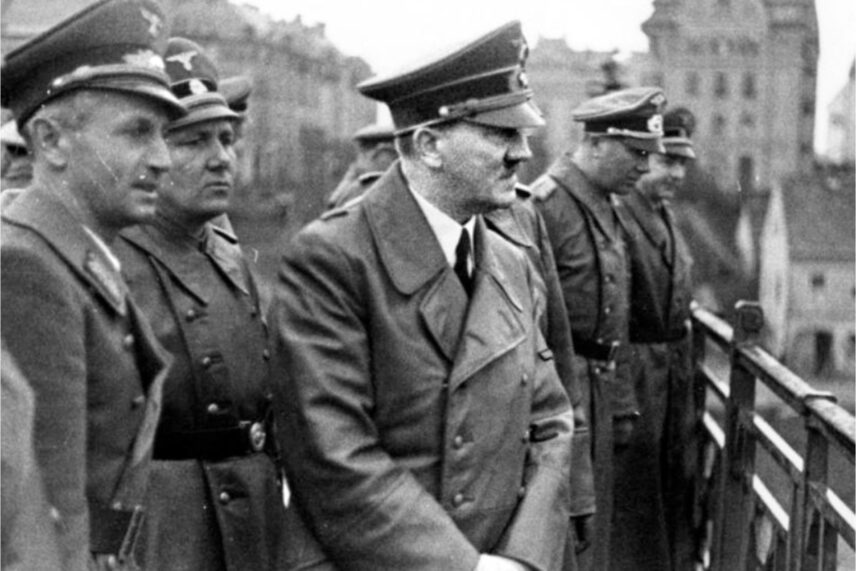
3. The Death of the Führer
On April 30, 1945, the official account states that Adolf Hitler shot himself in the temple and his mistress, Eva Braun, ingested cyanide in the Führerbunker in Central Berlin as the Allies closed in. However, doubts arose around the Führer’s suicide, fueled by conflicting Soviet reports and the absence of definitive physical evidence presented to the public. Among the most persistent conspiracy theories is the notion that Hitler and other high-ranking Nazis escaped, possibly to a secret enclave in Argentina.
The capture of Albert Eichmann in Argentina in 1960 and the identification of the late Josef Mengele in Brazil in 1985 only further fueled these theories. Notably, declassified FBI files and other sources reveal that many Nazis used “ratlines” to flee to South America post-WWII, but no concrete evidence includes Adolf Hitler among them. While the Führer’s death spurned an ongoing mystery, the most compelling proof places him dead in the Führerbunker in 1945.
4. The Rumors of an Undead Nazi Army
At the heart of the rumors and myths surrounding an undead Nazi army lies a kernel of undeniable truth — the regime’s cruel and bizarre medical experiments that aimed to create super-soldiers. This grim reality morphed into widespread rumors that the Nazis were attempting to resurrect the dead. This trope has transcended time, inspiring decades of media portrayals, including many war movies that could entertain more than those seeking historical facts alone.
This media also includes books and video games, with the notorious Wolfenstein and other series making a strong case for inclusion on the list of the most violent video games in history. In modern culture, the idea of an undead army continues to reverberate, merging historical horrors with fantastical fiction, leaving audiences both riveted and disturbed.
5. The Buried Treasure of The Nazi Gold Train
Legend has it that a Nazi train loaded with gold, jewels and priceless artwork vanished into a secret tunnel system in the mountains of Lower Silesia, now part of Poland, in 1945. This mystery gained traction in 2015 when two amateur explorers claimed to have found the treasure’s location using ground-penetrating radar, which sparked a government-sanctioned excavation that ultimately turned up empty. Another unrelated 2025 search has so far turned up empty but remains ongoing pending permissions.
Also known as the “Nazi Ghost Train”, the elusive Gold Train is symbolic of the vast quantities of looted wealth that remain unaccounted for, reminiscent of other ambitious but ultimately fruitless projects of the era. These include ambitious undertakings such as the mysterious Antarctic Snow Cruiser, which disappeared without a trace after being left abandoned on the icy southernmost continent.
6. Foo Fighters’ Ghost Fleet of Spectral Sightings
The foo fighter phenomenon refers to the strange sightings reported by many Allied pilots during WWII, where small metallic spheres or colorful lights would follow their aircraft at incredible speeds. Believed by airmen to be secret Nazi weapons, these lights reportedly even maneuvered alongside their planes, not appearing on radar and sometimes displaying intelligent behavior, but never directly engaging in combat. Richard Ziebart, a 415th Night Fighter Squadron historian, believed the foo fighters comprised plain light and no more, but could offer no further explanation.
Military intelligence took the foo fighter sightings seriously but never released an official explanation for the phenomenon. Far from being isolated in their appearances, the foo fighters were part of a broader wartime trend that included reports of ghost ships and phantom planes, all of which contributed to the eerie atmosphere of the era. Together, these spectral sightings weave a tapestry of high strangeness that blurs the lines between reality and supernatural mystery, captivating historians and WWII enthusiasts alike.

7. The Sunken Mystery of the HMS Trooper
After over 80 years of puzzling WWII historians, a Greek diver and researcher solved the mystery of the HMS Trooper’s disappearance. The British submarine and its crew of 64 had vanished during a mission in the Aegean Sea in 1943, leaving its fate a lingering enigma. After many hours of searching and research, Kostas Thoktaridis and his team finally discovered the T-class sub’s wreckage in 2024, broken into three distinct pieces at a depth of over 800 feet between the Aegean islands of Ikaria and Donousa.
Evidence reveals that the submarine struck a German EMF-type mine, solving this long-standing WWII cold case and eventually providing closure to families and frustrated historians alike. The HMS Trooper’s tower hatch was open and its periscope lowered, likely meaning the submarine was on the surface when it exploded. The craft’s discovery can go some way to enhancing the understanding of WWII combat, while also highlighting the enduring quest for lost history beneath the waves.
Unraveling the Secrets of WWII
The enduring fascination with WWII mysteries highlights humanity’s desire to uncover hidden truths and forgotten stories. While you’ll find some secrets remain lost to time, the ongoing search for answers continues to shed light on this pivotal and chaotic period in history. Each discovery will enrich your understanding of the time and illustrate how the echoes of the past still resonate into today, captivating historians and your personal interest as you dig deeper into the shadows of a world forever altered by conflict.