As an Amazon Associate, Modded gets commissions for purchases made through links in this post.
Everyone has seen movies with humans doing seemingly impossible acts like scaling buildings simply by running fast. Then it smoothly transitions to Olympic-worthy acrobatics while flowing through traffic. It’s time to understand freerunning vs. parkour — which one is which and how are they different?
History of Parkour and Freerunning
In 1902, French naval officer Georges Hébert was tasked with completing a rescue mission after the eruption of Mount Pelée. This event led him to a future in physical education, teaching fundamentals like balancing and quadrupedal movement. This is what inspired the basis for parkour almost a century later.
Invented by Frenchman David Belle, parkour and freerunning originated from French military training programs for their special forces in the 1990s. They began as obstacle course-style training sessions, teaching hard skills like agility and strength and soft skills like resourcefulness and environmental awareness.
Eventually, practitioners — also called traceurs — created the parkour group Yamasaki, which was heavily influenced by Asian martial artists like Jackie Chan and Bruce Lee. Yamasaki began traveling and making television appearances to spread awareness.
In 2003, Sebastien Foucan created a documentary called “Jump London” to highlight three French traceurs, which popularized the idea of freerunning. This was to construct a more fluid form of the sport, focusing on artistry instead of efficiency.
In the modern era, the World Freerunning Parkour Federation describes the sport as a philosophy. They claim the sport encourages a specific mindset — no matter what obstacles exist, there is freedom in knowing you can overcome them.
Training and Techniques, Explained
From the French “parcour” meaning “the way through,” parkour is an athletic discipline in which traceurs attempt to get from point A to point B as efficiently as possible. This is without tools and equipment.
By definition, freerunning is both athletic and acrobatic, but with a priority over artistry over maximum efficiency. Both use the same core teachings, with freerunning adding more visual style.
Parkour can include many types of athletic prowesses, including but limited to vaulting and rolling. Here is some example of traditional moves in parkour:
- Bar Kip: The ability to swing below a bar with enough force to mount or get front support. This can allow them to propel forward or do any subsequent tricks.
- Kong Vault: This is when someone is running and moves over an object so it propels them forward. It’s specifically helpful when moving over long obstacles.
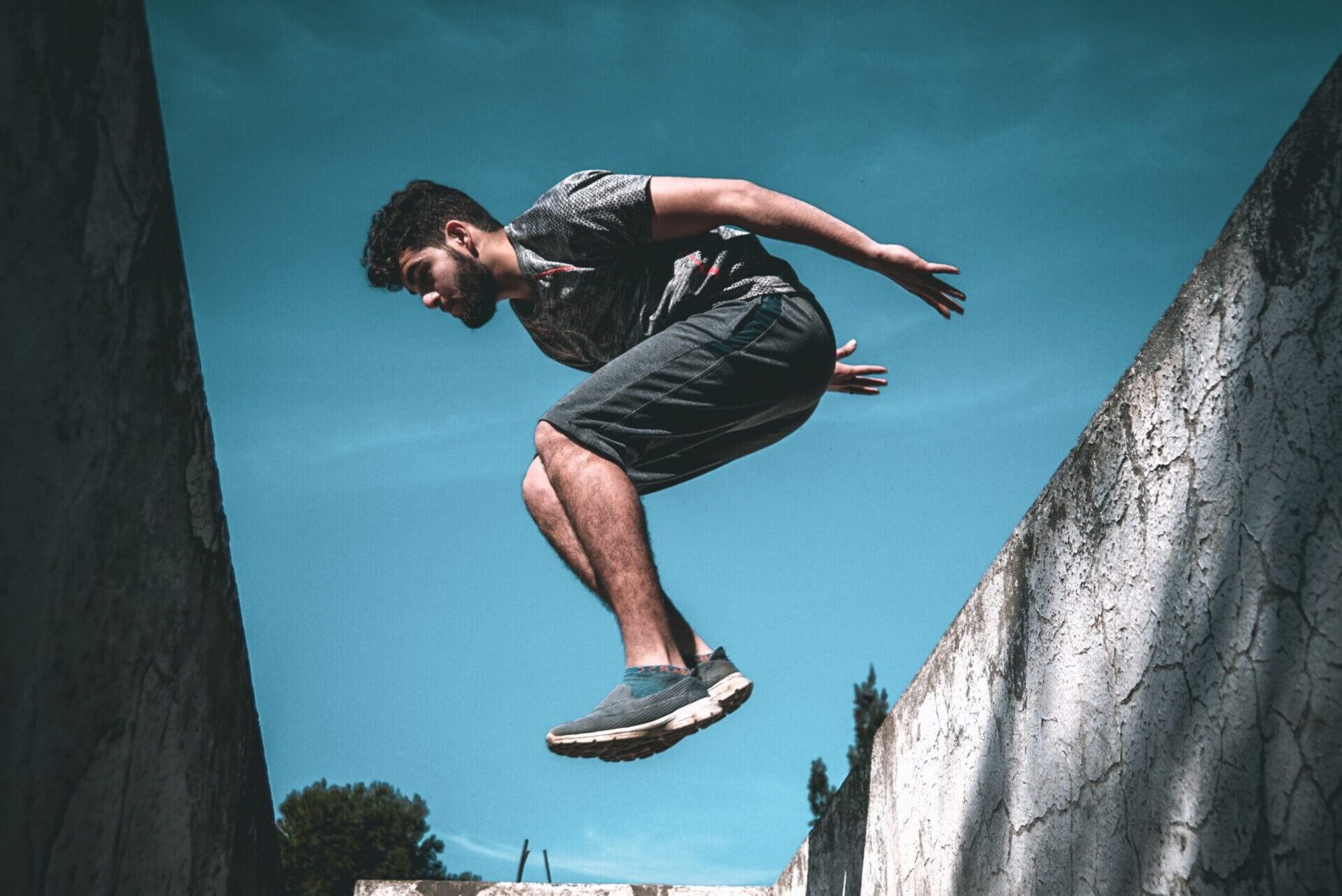
- Tic Tac: One of the most well-known parkour movements — often portrayed in films — is when the runner pushes off a wall with their foot. They angle in a way that allows them to hop off diagonally forward to continue running or provide momentum for sequenced jumping.
- Safety Roll: Used in other martial arts, this is a breakfall performed by rolling with a shoulder and the opposite hip. It’s meant to decrease pressure on the body and encourage speed by dispersing force.
- Cat Leap: A traceur performs this by scissoring their legs, one turned out and one tucked. Using this momentum, the athlete can grip the tops of walls and move upward with the power from the legs.
With elements of many sports — including modern-day gymnastics and martial arts — it has gained popularity by being a great muscle-builder. Its visual intrigue also grips spectators’ interest, as it continues to appear in modern film and video games.
Influence Around the Globe
One of the significant resurgences of parkour and freerunning came from major blockbuster hits like Casino Royale. The movie incorporated parkour and freerunning as a way to elevate the caliber of James Bond’s stunts.
Foucan even starred in Casino Royale and the popular Electronic Arts video game Mirror’s Edge, showing off his skills. This game allowed players to experience parkour in a first-person action-adventure platformer safely.
The publicity gained the notice of the International Olympic Committee, which began considering parkour and freerunning’s inclusion in the games. Practitioners hope it doesn’t ascend to that level. Parkour represents something different ideologically, focusing on exploration of the world, free of competition. Freerunning was developed as a more competitive alternative despite its preference for visual flair. However, the desire for it to be in the Olympics is still minimal.
The group chief executive for Parkour Earth further rejected their inclusion in the Olympics by saying it would whitewash the sport and jeopardize its historical integrity. To this day, it is still absent from the games. Still, it continues to gain popularity globally with more training options and community participation options.
Freerunning vs. Parkour — Freedom from Obstacles
With its pure athletic and acrobatic beauty, freerunning and parkour both impress with their demonstration of strength and dexterity. The popularity is likely to rise in upcoming years. Whether it comes to the Olympics or not, the trend could spread worldwide through media, storytelling and the internet by spreading addictive videos of humans and their incredible athleticism.