As an Amazon Associate, Modded gets commissions for purchases made through links in this post.
Most guys know protein is good for you. Most men mistakenly view protein as just a muscle-builder, ignoring its role in fat loss. But when fat loss is the goal, protein might be doing more quiet, consistent work than any other part of your diet. It keeps hunger manageable, protects the muscle you have and costs your body more energy to digest. The question isn’t whether you need it, but how much — and where to get it.
Why Protein is the Macronutrient Worth Paying Attention To
Before getting into numbers, it helps to understand what protein is actually doing when you are in a deficit.
Losing weight is not the same as losing fat. That distinction matters more than diet advice lets on. Cut calories without enough protein, and your body burns both fat and muscle. Losing muscle slows your metabolism, leaves you feeling weaker and tends to make the weight come back faster once you stop restricting.
Protein addresses that directly. It fills you more than carbs or fat, which means you eat less without white-knuckling your way through hunger. It also has a higher thermic effect, meaning your burn more calories digesting it than you do processing other macronutrients. Beyond that, it helps stabilize blood sugar levels, which can prevent the sudden cravings associated with insulin spikes. Higher protein intake supports lean mass preservation during a calorie deficit, which is the whole goal.
How Much Protein Per Day Do You Need?
There is no single number that works for every man. The most commonly cited guidance sits at 0.8 grams of protein per pound of body weight per day. For most men trying to lose fat while holding on to muscle, landing somewhere in the middle of that range is a reasonable and realistic starting point.
Where you land depends on a few things. If you are fairly sedentary, the lower end is usually enough. If you’re lifting regularly or doing intense cardio days, push closer to one gram per pound. Age is a factor, too. Men over 40 tend to lose muscle more easily due to sarcopenia, so a slightly higher intake can help offset that natural decline.
A 185-pound active man aiming to lose fat might target somewhere between 130 and 185 grams of protein per day. That is a wide window, but it gives you room to find what actually works for your appetite, your schedule and your cooking habits.
Your Protein Goals Based on Your Body
Setting your protein goals for weight loss becomes more useful when you stop thinking in abstract percentages and start thinking about your actual numbers. A couple of examples illustrate the range well.
Take a 200-pound man with a desk job who gets to the gym once or twice a week and is trying to drop around 25 pounds. His activity level is moderate. A reasonable daily protein target for him sits around 140 to 160 grams. That is enough to protect his muscle while his body runs in a deficit, without requiring a dramatic overhaul of his current eating habits.
Now take a 180-pound man who lifts three or four times a week and has a physically active job. He is not training for a competition, just trying to get leaner. His target would sit closer to 160-180 grams, sometimes nudging higher on heavier training days. To illustrate how that adds up, a single meal like ground turkey-stuffed peppers can pack as much as 55 grams of protein, getting him nearly a third of the way to his daily goal in one sitting.
Starting weight plays a role here, too. Heavier men need more protein, but as body composition improves, your target number decreases. The goal is not a perfect figure every single day. Consistency over weeks matters far more than precision on any given Tuesday.
Best Protein Sources for Meals
Not all protein sources are equal in practice. Some are more filling, some are easier to batch-cook, and some are versatile enough to work across multiple meals in the same week. These are the ones worth building your plate around.
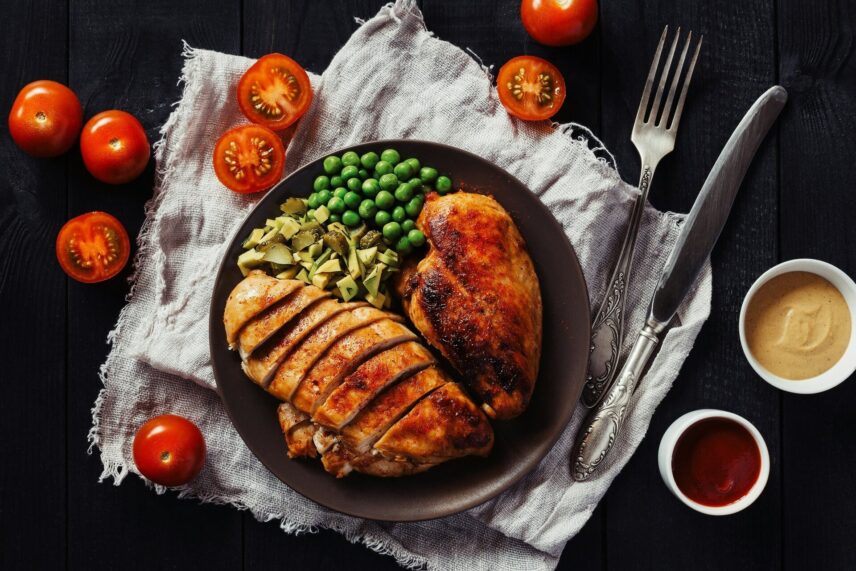
Chicken breast is lean, cheap, easy to prep in bulk and around 26 grams per three-ounce serving. There are six grams of protein per egg and you can enjoy them scrambled, hard-boiled or fried. Lean ground beef is a 90/10 that gives you roughly 22 grams of protein per three-ounce serving with enough fat to keep it satisfying.
Salmon contains around 22 grams of protein per serving, plus omega-3s that support joint health and inflammation. A cup of plain, non-fat Greek yogurt delivers 17 to 20 grams and works as a base for sauces, dips or just a fast breakfast. Cottage cheese is an underrated and slow-digesting protein with half a cup containing 14 grams of protein. Per cup of cooked lentils, there are about 18 grams of protein. Chia seeds are another powerful option, containing as much as 16.5 grams of protein per 100-gram serving and keep you fuller for longer.
Protein Snacks That Keep You Full
Snacking gets a bad reputation in fat loss circles, but the problem is usually the type of snack, not snacking itself. These options are easy to keep on hand and fill in between meals.
Hard-boiled eggs are easy to batch-prep at the start of the week and have a grab-and-go snack every day. Beef jerky contains around nine to 10 grams of protein per ounce or 30 grams for a whole cup. Watch the sodium on some brands, but it’s otherwise a solid option. String cheese gives six to eight grams per stick, which makes it the perfect, low-effort, easy-to-pick snack.
Edamame is another great option. A cup of shelled edamame has about 17 grams of protein and works well both warm and cold. Protein shakes can be a practical way to close a protein gap on busy days, though whole food sources should still anchor most of your intake throughout the week.
Making It Work Without Tracking
Tracking macros works well for some men. For others, it feels like a second job within a week. Either approach is fine. What matters more is building habits that make high protein intake the default rather than a daily effort. Making high-protein intake a habit, especially at breakfast, pays dividends beyond the scale. Studies suggest a protein-rich morning meal can improve cognitive function and memory throughout the day.
Anchor protein at every meal before you fill the rest of your plate. Use your palm as a rough guide. One palm-sized portion of a dense protein source per meal gets most men somewhere in the right range without a calculator. Cook in batches. Batch-cooking chicken or lentils minimizes daily decision-making and excuses for less healthy choices.
The Proof Is in the Protein
Setting your protein goals for weight loss does not require a nutrition degree or a spreadsheet. It requires a reasonable target, a handful of reliable food sources, and the patience to let it work over weeks rather than days. Most men who struggle with fat loss are not failing because of effort. They are under-eating protein and overcomplicating everything else. Start with your body weight in pounds, aim for 0.7 to one gram of protein per pound and adjust as you go.